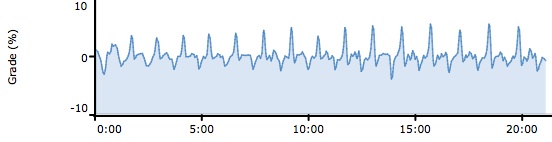
Queen Anne wind sprints: 6 minutes 37 seconds up 3rd Ave W from a certain telephone pole near Cremona to Howe, right on Howe and a half block west to the highest point on Howe.
I did it thrice. First good, second better, third not good, so done at 3. The graphs are for the second time.
Last bike workout until I leave for DC.
6.25.2011
6.23.2011
Driven to Run
Christopher McDougall, Born to Run: A Hidden Tribe, Superathletes, and the Greatest Race the World Has Never Seen.
Daniel H. Pink, Drive: The Surprising Truth About What Motivates Us.
Two books I borrowed from Aki.
Drive is about what motivates people, but even more, it's about what demotivates people. The best way to demomotivate? Take something a person does for the joy of it, and pay them to do it. Getting paid a salary isn't inherently demotivating, but things like giving people a bonus for reaching a sales target or giving a kid a candy bar for completing a homework assignment are inherently demotivating.
Author Pink emphasizes that the basis of his argument is not philosophical, but scientific: over and over, the data show that most of what organizations do to motivate people has the opposite effect, and that most bonus and compensation schemes are destructively counterproductive. People give less blood when you pay them for it. Test scores fall when you reward good scores. Sales force performance falls in the face of quarterly targets. Over and over and over. Ouch.
Pink concedes that some jobs just aren't very much fun, and are going to be done by people who don't enjoy them very much, but even here, he suggests that such jobs can be less dreary than typical if attention is paid to what people find satisfaction in.
What's the connection to a book on ultramarathon running and minimalist footwear? Born to Run is about these things, but also why people run ultramarathon distances. McDougall makes an interesting point on motivation: when American marathon sponsorship enabled runners to make a living running marathons, the effect on performance was rapid and dramatic: while world marathon times got significantly better, marathon times by Americans actually got worse. McDougall argues that turning marathon running into a job caused the performance drop. Pink would approve.
McDougall's book is about what supports running, both biomechanically and psychologically. He describes people for whom running is an escape, a salvation, a way of life, or all of these. Mostly, running happened to people who saw themselves as more than only a runner: nurse, farmer, surf bum, writer, and so on.
I have a little experience in amateur endurance sports. The rewards are the satisfaction of doing the thing, and maybe a bit of ribbon. Getting paid to do it would be very strange, perhaps like getting paid to smile, or getting paid to pray.
These books describe a world that is different than many people think they live in, and maybe a world different than many people want to live in. It is perhaps comforting to believe that motivating people is just pushing the right buttons. The evidence is that the human psyche is much slipperier than that. But isn't it more noble to be motivated best by a desire to do a thing well, just for its own sake?
Daniel H. Pink, Drive: The Surprising Truth About What Motivates Us.
Two books I borrowed from Aki.
Drive is about what motivates people, but even more, it's about what demotivates people. The best way to demomotivate? Take something a person does for the joy of it, and pay them to do it. Getting paid a salary isn't inherently demotivating, but things like giving people a bonus for reaching a sales target or giving a kid a candy bar for completing a homework assignment are inherently demotivating.
Author Pink emphasizes that the basis of his argument is not philosophical, but scientific: over and over, the data show that most of what organizations do to motivate people has the opposite effect, and that most bonus and compensation schemes are destructively counterproductive. People give less blood when you pay them for it. Test scores fall when you reward good scores. Sales force performance falls in the face of quarterly targets. Over and over and over. Ouch.
Pink concedes that some jobs just aren't very much fun, and are going to be done by people who don't enjoy them very much, but even here, he suggests that such jobs can be less dreary than typical if attention is paid to what people find satisfaction in.
What's the connection to a book on ultramarathon running and minimalist footwear? Born to Run is about these things, but also why people run ultramarathon distances. McDougall makes an interesting point on motivation: when American marathon sponsorship enabled runners to make a living running marathons, the effect on performance was rapid and dramatic: while world marathon times got significantly better, marathon times by Americans actually got worse. McDougall argues that turning marathon running into a job caused the performance drop. Pink would approve.
McDougall's book is about what supports running, both biomechanically and psychologically. He describes people for whom running is an escape, a salvation, a way of life, or all of these. Mostly, running happened to people who saw themselves as more than only a runner: nurse, farmer, surf bum, writer, and so on.
I have a little experience in amateur endurance sports. The rewards are the satisfaction of doing the thing, and maybe a bit of ribbon. Getting paid to do it would be very strange, perhaps like getting paid to smile, or getting paid to pray.
These books describe a world that is different than many people think they live in, and maybe a world different than many people want to live in. It is perhaps comforting to believe that motivating people is just pushing the right buttons. The evidence is that the human psyche is much slipperier than that. But isn't it more noble to be motivated best by a desire to do a thing well, just for its own sake?
6.07.2011
Tahuya Hills 600
30 hours 57 minutes. Three minutes faster than my goal, as it happens.
This ride goes nigh well all over northwestern Washington. From Seattle pretty far into Mt. Rainier park, west through Centralia onto the Olympic Peninsula, around Hood Canal to Port Gamble, and finally into Winslow on Bainbridge Island. Whew!
Would I do it again? Yes, I'd do it all again just to ride through the twilight along Hood Canal, as if I and the small group I was riding with were the only people on earth.
As with any ride like this, so many cool things happened. I loaned out tools to people who needed them and got them back. People loaned me things I needed and they got them back. We saw the fans waiting for the U2 concert at 6am. The guy in Seabeck who called us "Marine Tough" without asking us where we were going, because he'd seen our tribe before. Hammering the last 7km to finish in just under 31 hours because we were pretty sure we could so we should try, but only if all seven of us could do it together. And most of all, truly wonderful volunteers, who cared for us as if we were the most important people on earth to them.
Yeah, it was pretty long, but this ride is half as long as PBP. Half. Every time I double the distance, I go about 1.5 kph slower, which suggests a PBP time of about 67 hours. Sweet!
Except, that would mean not sleeping for 67 hours. I don't think I'm going to do that. I think I'm going to get some sleep along the way, probably twice. And I'm not sure the 1.5 kph math holds up anyway. But this 600 was a big confidence booster for PBP. I finished about as fast or faster than a lot of people who are planning to finish PBP and have good reason to believe they can do it.
This ride goes nigh well all over northwestern Washington. From Seattle pretty far into Mt. Rainier park, west through Centralia onto the Olympic Peninsula, around Hood Canal to Port Gamble, and finally into Winslow on Bainbridge Island. Whew!
Would I do it again? Yes, I'd do it all again just to ride through the twilight along Hood Canal, as if I and the small group I was riding with were the only people on earth.
As with any ride like this, so many cool things happened. I loaned out tools to people who needed them and got them back. People loaned me things I needed and they got them back. We saw the fans waiting for the U2 concert at 6am. The guy in Seabeck who called us "Marine Tough" without asking us where we were going, because he'd seen our tribe before. Hammering the last 7km to finish in just under 31 hours because we were pretty sure we could so we should try, but only if all seven of us could do it together. And most of all, truly wonderful volunteers, who cared for us as if we were the most important people on earth to them.
Yeah, it was pretty long, but this ride is half as long as PBP. Half. Every time I double the distance, I go about 1.5 kph slower, which suggests a PBP time of about 67 hours. Sweet!
Except, that would mean not sleeping for 67 hours. I don't think I'm going to do that. I think I'm going to get some sleep along the way, probably twice. And I'm not sure the 1.5 kph math holds up anyway. But this 600 was a big confidence booster for PBP. I finished about as fast or faster than a lot of people who are planning to finish PBP and have good reason to believe they can do it.
5.22.2011
Today's workout: not much for scenery.
Riding around in circles in a parking lot. Not much scenery, and what there is, you get to see a lot of.
I think I would have trouble doing this every week, but this week it worked out pretty well. I feel like the engine I need is half-built. From a cardiovascular standpoint, I have what I need, which is good, because cardio capacity doesn't change all that fast, so in the 92 days from now to PBP, my cardio will improve, but not drastically. The two areas I'd like to be stronger are in getting the metabolic furnace able to throw more calories out, and to have greater leg power so I can produce higher power for longer without fatique.
Metabolism comes from doing long rides. I have the miles laid out between now and PBP, so the thing I want to work on now is power. Since going faster requires more power, you can work on power with "speed" work. (And I want the power not to increase my maximum speed, but the speed I can sustain for days on end.)
So, warm up and then go as fast as possible for about 20 minutes, say for 2 reps. This is too long to get through it with an anaerobic sprint.
The other complicating factor is that the replacement for my broken middle chainring won't come in until Thursday, so I needed a pretty flat course that would allow me to stay in the big ring.
So, ride out to Husky statium, and do loops around the parking lot. Good enough.
Yep, a pretty flat loop.
I think I would have trouble doing this every week, but this week it worked out pretty well. I feel like the engine I need is half-built. From a cardiovascular standpoint, I have what I need, which is good, because cardio capacity doesn't change all that fast, so in the 92 days from now to PBP, my cardio will improve, but not drastically. The two areas I'd like to be stronger are in getting the metabolic furnace able to throw more calories out, and to have greater leg power so I can produce higher power for longer without fatique.
Metabolism comes from doing long rides. I have the miles laid out between now and PBP, so the thing I want to work on now is power. Since going faster requires more power, you can work on power with "speed" work. (And I want the power not to increase my maximum speed, but the speed I can sustain for days on end.)
So, warm up and then go as fast as possible for about 20 minutes, say for 2 reps. This is too long to get through it with an anaerobic sprint.
The other complicating factor is that the replacement for my broken middle chainring won't come in until Thursday, so I needed a pretty flat course that would allow me to stay in the big ring.
So, ride out to Husky statium, and do loops around the parking lot. Good enough.
Yep, a pretty flat loop.
5.17.2011
The mother of all road debris
OK, not as impressive as the truck that dumped an entire rack of window glass in the street in front of my building, but I didn't pick up any of that --the city and the glass company handled it.
This is pretty impressive compared to the normal bits of metal I remove from the streets. Two nine foot aluminum brackets. They had been in the street probably only a few minutes when I came by, but passing cars were already beating them to bits. By the sound of it, some of those drivers will later find out that they damaged their tires. Eventually, cars would probably have smashed them into something like aluminum ninja stars. Nice. It's actually a felony to not secure your load properly in Washington. The meatheads who let these fall off of their truck are why such laws are necessary.
5.15.2011
Baker Lake 400: a little damp
A pretty day riding from Redmond out to Baker Lake on the flanks of Mount Baker, then back to Granite Falls. This isn't the prettiest scene, that would be up in the mountains. But this was a convenient place to stop.
However, while the day ended in Granite Falls, the ride didn't. We still had to get back to Redmond. It started raining. Then raining harder. Then harder still. All together, over an inch of rain between about 8pm and 2am. Total time: 19h 57m. My goal was 20 hours, so I guess that's good.
Oh, and I broke the middle chain ring a few hours into the ride. I could shift through it from the big ring to the little ring, but it took about twice as long as blowing a shift would normally, so impossible in a pace line. Consequently, I spent a lot of time in the big cog and the big ring, not wanting to lose momentum while I shifted up a few cogs, then dropped the chain from the big ring to the middle, then without applying much force shifted from the middle to the small ring. Then shifted up a few more cogs. Then once the hill flattened out a bit, the same thing in reverse. To avoid all that, I ended up standing on the pedals a good deal.
Oh, and I hit a dog in the rain. A big dog. Ran right out in front of us. I hit it behind the shoulder so it might have a cracked rib but at least not a broken shoulder, and the dog ran off, so I think the dog's OK. I was surprised I didn't go down, but I hit the dog dead on and I'd managed to slow down some already, so it all worked out.
However, while the day ended in Granite Falls, the ride didn't. We still had to get back to Redmond. It started raining. Then raining harder. Then harder still. All together, over an inch of rain between about 8pm and 2am. Total time: 19h 57m. My goal was 20 hours, so I guess that's good.
Oh, and I broke the middle chain ring a few hours into the ride. I could shift through it from the big ring to the little ring, but it took about twice as long as blowing a shift would normally, so impossible in a pace line. Consequently, I spent a lot of time in the big cog and the big ring, not wanting to lose momentum while I shifted up a few cogs, then dropped the chain from the big ring to the middle, then without applying much force shifted from the middle to the small ring. Then shifted up a few more cogs. Then once the hill flattened out a bit, the same thing in reverse. To avoid all that, I ended up standing on the pedals a good deal.
Oh, and I hit a dog in the rain. A big dog. Ran right out in front of us. I hit it behind the shoulder so it might have a cracked rib but at least not a broken shoulder, and the dog ran off, so I think the dog's OK. I was surprised I didn't go down, but I hit the dog dead on and I'd managed to slow down some already, so it all worked out.
5.06.2011
Weight Trailing
Lead automobile wheel weight. Removed from Nickerson Street.
Fishermen aren't supposed to fish with lead weights any more. Consumer electronics are increasingly lead-free. Bad for the environment, children's brains, and so on. Not hard to understand.
So why is it still legal to haphazardly smash a blob of lead to the rim of a poorly-made car tire, in the full knowledge that it is likely to come flying off at some point, be pulverized by passing cars, and end up in stormwater, as dust in children's lungs, and so on?
What is the great social benefit from putting these weights on car wheels? AFAIK, basically nothing happens to the car when these weights fall off, and wheels that are slightly above completely crappy can't even have these weights put on them. Why do we tolerate this nonsense?
Fishermen aren't supposed to fish with lead weights any more. Consumer electronics are increasingly lead-free. Bad for the environment, children's brains, and so on. Not hard to understand.
So why is it still legal to haphazardly smash a blob of lead to the rim of a poorly-made car tire, in the full knowledge that it is likely to come flying off at some point, be pulverized by passing cars, and end up in stormwater, as dust in children's lungs, and so on?
What is the great social benefit from putting these weights on car wheels? AFAIK, basically nothing happens to the car when these weights fall off, and wheels that are slightly above completely crappy can't even have these weights put on them. Why do we tolerate this nonsense?
5.05.2011
Must Be Spring
A shiny new spring, removed from Western Ave at Warren. Sven thinks it's part of a bicycle suspension. Maybe.
5.04.2011
Cytokine Storm
One consequence of the Rainiest Seattle Spring Ever is that all of the trees pollinated at once, namely Tuesday.
When a doctor describes your current health with the term "Cytokine Storm," you know it's a bad year for allergies.
Tree sex season can't end too soon. Really, get a room y'all.
When a doctor describes your current health with the term "Cytokine Storm," you know it's a bad year for allergies.
Tree sex season can't end too soon. Really, get a room y'all.
5.01.2011
Debris Field Report
On January 3, I reported spikes in the road at 26th Ave and E. Galer to SDOT. As of this morning, they're still there.
The city puts these spikes into the road to hold down air hoses for traffic studies. They're supposed to pound them down after the traffic study is over. They don't always do that, and based on the number of these I see around town, I think they may not pound them down most of the time. Even when I point them out to SDOT, the crews seem to have trouble finding them. Are they really that hard to see? I don't have any trouble spotting them, and my eyes certainly aren't what they used to be. Maybe SDOT should use nails that are easier to spot, or else keep better track of where they put them. When the crew is pulling up the air hoses, it really should be pretty easy to figure out how many nails they have to pound down.
Look how shiny the heads of these spikes are. Plenty of people have been running over them. This is a designated, signed bike route, and the spikes are about 3' from the curb, where most bikers ride on this street.
The city puts these spikes into the road to hold down air hoses for traffic studies. They're supposed to pound them down after the traffic study is over. They don't always do that, and based on the number of these I see around town, I think they may not pound them down most of the time. Even when I point them out to SDOT, the crews seem to have trouble finding them. Are they really that hard to see? I don't have any trouble spotting them, and my eyes certainly aren't what they used to be. Maybe SDOT should use nails that are easier to spot, or else keep better track of where they put them. When the crew is pulling up the air hoses, it really should be pretty easy to figure out how many nails they have to pound down.
Look how shiny the heads of these spikes are. Plenty of people have been running over them. This is a designated, signed bike route, and the spikes are about 3' from the curb, where most bikers ride on this street.
4.23.2011
Minimalism
First the bike with one speed. Now running without shoes. There is satisfaction in dispensing with an essential, and finding you don't miss it.
4.17.2011
Wind Sprints
After the climb up Golden Gardens Drive starts getting easier, it's time to move on to the climb up Queen Anne Hill. Starting at the intersection of 3rd Ave W and W Bertona St., head south up 3rd to Howe. Turn right on Howe, stopping at the high point where the alley crosses Howe. Then catch your breath and do it again. Very slightly over 1 mile, with about 390' of climb. This builds power, and covers performance over a size of climbing pitch one often finds, as well as the length of time one typically spends at the front of a paceline.
The grade is around 7%, and doesn't vary much, except where it flattens out at the end.
I ride as hard as I can, for between 2 and 4 reps. Two is all you really need, so that's all I ever commit to when I start, so I don't hold anything back. If I feel great after 2 I might do one or two more, but I doubt there's much benefit from more than 4 reps.
Two years ago, I started out doing it in 8 minutes in the spring, working down under 7 minutes by late summer. This year, I'm starting out at 6:47. So I'm off to an early start, because I have to be. PBP is only 125 days away. I need to start shifting away from strength and power towards endurance training, but the rando riders finishing ahead of me are stronger than me in the hills. I think I have the materials to accomplish PBP, but there's no point taking any chances.
The grade is around 7%, and doesn't vary much, except where it flattens out at the end.
I ride as hard as I can, for between 2 and 4 reps. Two is all you really need, so that's all I ever commit to when I start, so I don't hold anything back. If I feel great after 2 I might do one or two more, but I doubt there's much benefit from more than 4 reps.
Two years ago, I started out doing it in 8 minutes in the spring, working down under 7 minutes by late summer. This year, I'm starting out at 6:47. So I'm off to an early start, because I have to be. PBP is only 125 days away. I need to start shifting away from strength and power towards endurance training, but the rando riders finishing ahead of me are stronger than me in the hills. I think I have the materials to accomplish PBP, but there's no point taking any chances.
4.16.2011
Another way of looking at seasonal weight
The vertical axis is weight in kg. Horizontal axis is days since New Year. Each line represents weight as measured for one year, beginning January 1 of that year.
The data are incomplete, so the apparent weight gain starting in July is mostly an artifact of not having much late summer data.
This shows that in many years, I put on around 5 kg (~10 lb) over the holidays, then work it off in the spring. In 2010, I started working that weight off unusually late, in April, and I paid for it. This year, I had more physical activity earlier in the year than usual, and I made an effort to watch what I ate. The results show above. My scale's crude estimate of BFI is 13%.
The data are incomplete, so the apparent weight gain starting in July is mostly an artifact of not having much late summer data.
This shows that in many years, I put on around 5 kg (~10 lb) over the holidays, then work it off in the spring. In 2010, I started working that weight off unusually late, in April, and I paid for it. This year, I had more physical activity earlier in the year than usual, and I made an effort to watch what I ate. The results show above. My scale's crude estimate of BFI is 13%.
4.15.2011
More road debris.
Some sort of metal plates in the bike lane on Nickerson. Not super sharp, but probably sharp enough to get through a sidewall if you hit it right.
4.05.2011
A Prayer to Hypoxia
In mountain and slope I seek you
To feel you pervade my body
To make you an offering
Of everything I have
Take the breath from my lips
Take the salt from my pores
Take the fire from my hearth
Take the fuel from my stores
Take all I bring you
They are yours already
I never owned them
I gathered them for you
I will meditate
Each journeyed moment
I will turn the crank
Spin my spoked prayer wheel
To feel you pervade my body
To make you an offering
Of everything I have
Take the breath from my lips
Take the salt from my pores
Take the fire from my hearth
Take the fuel from my stores
Take all I bring you
They are yours already
I never owned them
I gathered them for you
I will meditate
Each journeyed moment
I will turn the crank
Spin my spoked prayer wheel
Subscribe to:
Comments (Atom)