8.28.2014

Tools and Toys

A nine year old girl shot and killed an instructor on a gun range in Nevada yesterday.

Here's a picture of my son with the products of his first big date with a plasma arc welder. He's older than nine, of course, but he started using air hammers, drill presses, and hammer drills when he was around eight. He started using a die grinder when he was ten. These tools are useful, but can maim or even kill if handled poorly.

So why does this not feel the same as putting a automatic weapon in a little girl's hands? Yes, an Uzi is a dangerous object with notorious muzzle climb that a small child is inherently going to have trouble controlling. By comparison, a hammer drill has a much more limited potential to get out of hand.

But that's not the salient point. A hammer drill is a tool for making holes in concrete and such. That's what we use it for. I taught my boy to use it so he could do real work with it around the place. An Uzi, in contrast, is a weapon of war. There is no target shooting class you can use an Uzi in, certainly not in full-auto. Blowing through a clip on an Uzi is not a sport. A civilian shooting an Uzi is taking a soldier's tool and treating it like a toy. Part of what seems so wrong about the Nevada shooting is that the little girl wasn't learning the sport of shooting: she was playing the game of war with a real weapon, and the weapon worked as designed.

I'm guessing my mom learned to shoot when she was around nine. I learned when I was a little older than that. I like going to gun ranges and shooting guns. If I didn't have a bad feeling about killing things, I'd probably hunt. So I actually kind of understand why parents would take their nine year old girl to a gun range. Kind of. Maybe twelve would have been better. And I understand that guns are pretty important to them, so in the same way I want my son to know the tools so he can be a maker and make things, they want their girl to be a shooter. I cringe at the idea of putting firearms at the center of your identity, but I can't pick for somebody else.

But treating weapons as toys is a problem, and this incident shows one reason why. There is a little thrill of focussed attention that never goes away when you are handling a dangerous object, but if that thrill becomes the point, and you start needing bigger and bigger hits of it, then your hobby is more than just a hobby. This is so far away from target shooting as a sport. There is no sport here, only playing dangerous games.

Condolences to the survivors of the incident in Nevada.

8.07.2014

Ebola shows we learned too little from AIDS

The largest Ebola outbreak ravages out of control in Africa as WHO considers declaring a public health emergency on suspicion of the disease reaching Saudi Arabia.

Ebola is a health and humanitarian disaster, and a serious infectious disease threat, but a separate WHO action shows systematic weaknesses in how new drugs are researched, developed, approved, and delivered to patients. On August 6, WHO announced an ethics panel to decide if and how to use experimental therapies for Ebola.

If this all sounds a bit familiar, it should. In the depths of the AIDS crisis, patients clamored for access to new drugs with unknown risks. There were no protocols in place. Haphazard experimentation on patients is illegal as well as unethical. But people were dying. Patient advocates created the political will to overcome these obstacles, and let patients choose risks using the meager information available. The result: many, many lives saved.

What did we learn from the AIDS crisis about how to better manage medical research? Approximately nothing. AIDS remains an exception in healthcare research, in every sense of the word. For example, NIH-funded AIDS research still has separate deadlines and mostly separate review from all other medical research. In our thinking, we've quarantined the whole AIDS crisis itself, as an event. Sure, we rethought what "patient" and "clinical trial" meant for AIDS because we had to. But we're not going to let that infect our thinking in other areas of medicine.

Ebola has no cure or effective treatment. Our response to Ebola is essentially medieval, because we have nothing better. Vaccines and drugs have not been developed, because most people who get Ebola are poor. Clearly, the economic costs of Ebola outbreaks would justify significant development costs. The costs of fighting just this one outbreak will be in the hundreds of millions of dollars, and I suspect the total economic losses will be in the billions. So even though the people who get Ebola don't have much money, it still makes economic sense to prevent Ebola outbreaks. Why then don't we?

There is an experimental drug, ZMapp, that has been manufactured in very small quantities. It has been tried on two Ebola patients. Controversially, those patients were both white health workers. Some in Africa now demand that wider access to ZMapp be provided, or at least considered. If this sounds like AIDS all over again, well, it's not much different.

Getting an approved drug to market is expensive, perhaps a billion dollars, depending on how you count. (There are many ways to count, but they all lead to very large numbers.) A poorly-managed trial could prevent a drug from ever being approved. That means never helping many people, and not incidentally never making back money invested in development. So drug companies are nervous about offering unapproved drugs to desperate people, for both ethical and financial reasons.

Why is ZMapp in short supply? Is it hard to make? Yes and no. ZMapp is a combination of three antibodies extracted from transgenic tobacco plants. Tobacco plants grow as fast as tobacco plants want to grow, so while manufacturing of ZMapp is ultimately scalable, the lag to get more drug is real: somebody literally has to plant tobacco plants in a greenhouse and wait for them to grow.

Other, faster manufacturing platforms could be considered, but ZMapp's manufacturer has disincentives to do this: to get a drug approved by the FDA (or elsewhere in the world) only trials using material from the exact manufacturing process used for the production drug can be used to support approval. This is for good reason, of course, particularly for a biotech drug like ZMapp. For biotech drugs produced in yeast, even changing the size of the incubation chamber can change the impurities that must be filtered out of the final drug.

But these are some of the reasons that stack up a billion dollars in front of getting a new drug approved. The AIDS crisis showed us we need to change our thinking. We changed our thinking. Then, when the AIDS crisis abated, we changed our thinking right back. This Ebola outbreak and the resulting humanitarian, moral, and ethical crises show that we learned little from the AIDS outbreak.

We have to drive the cost of drug development back down, and get drugs into the hands of patients sooner. That means that patients will get drugs with safety profiles that are less well understood. This means that we will have accept that some of these drugs will have side effects, and some people will be hurt or killed by those side effects. We can work towards drugs with better side effect profiles, and in fact drugs like ZMapp will mostly be quite safe. Mostly. But not always. So only patients who face serious risks in the absence of treatment should be offered these therapies, and they should be fully informed of the risks.

This is not an abstraction for me. Someone close to me participated in several clinical trials to combat an extremely dangerous disease that ultimately killed them. One of those trials was for an antibody therapy. Overall, experimental drugs made a horrible and lethal disease manageable and survivable. At least for a while. But the disease ultimately proved fatal, and in this case a bad reaction to antibody therapy probably hastened the end. What I learned is that this is hard in the abstract, but at the individual level, it's even harder, because you really don't know what's going to happen.

The changes I outline here, which encompasses ideas of both adaptive and pragmatic clinical trials, integrate clinical trials into clinical practice. This happens in two ways. First, clinical trials themselves are designed to answer questions about clinical practice and real benefit to patients, and adapt to meet patient needs as they progress. Second, drugs are approved, sooner, but approval is contingent on continuing investigation of how patients react to the drug.

This results in a faster drug development cycle, benefitting patients sooner and cutting the cost of drug development, encouraging more drugs to be developed. But, initial patient populations are smaller, have clearer risk/benefit relative to taking the drug, and are more carefully monitored. So, side-effects are more likely to be found earlier, when fewer patients have taken the drug.

A perfect world? Hardly. But a better world, with safer, more effective drugs that are cheaper and more widely available. The drug industry is complicated enough that even this massive change would not solve all of it's problems. But it would make a great difference.

(For more information from people who've thought about this stuff a lot more than I have, google "pragmatic trial" and "adaptive trial".)


11.21.2013

Blowing a Gasket

What's left of the combustion air gasket of our condensing boiler.

Condensing boilers are great, but the pH of the exhaust can be pretty low. Low enough to dissolve the gasket that came with the boiler. So Triangle, the manufacturer, came out with a replacement kit with a gasket that is much tougher than the stock HDPE o-ring it came with.

What you are looking at is the remains of this replacement gasket in the cleanout for the boiler's drain line.

Now Triangle has a new gasket kit with a supposedly even better gasket. Let's hope I'm $28 from a correctly working boiler.

Does this matter? A little. The exhaust is corrosive, so when the gasket's gone there is always a little corrosive, humid air leaking into the basement. Not very much, but the gasket's there in the first place because your flue isn't supposed to leak into your house.

Oh, and carbon monoxide, but not much of that on a condensing boiler, and I have a CO sensor in the basement. So far, no detectable CO.

I think anybody with gas-fired space heat or water heater should have a CO sensor. They're cheap, so there's no reason not to.

It also doesn't hurt to look over all your major systems fairly thoroughly once a year. I caught this one pretty much by accident because my father-in-law and I were talking furnaces and one thing led to another. I have a list of annual maintenance items. Checking the boiler cleanout for signs of gasket degradation is now on the list.


11.01.2013

Survival Mode vs. Creative Mode

Worldwide CAD users: about 44 million. Of those, 40 million are using Minecraft, and about 4 million are using everything else.

It could be because Minecraft is the only CAD system that includes a sword as a standard tool. It could be that at €20 (or free on a Raspberry Pi) Minecraft is very affordable.

Yeah, yeah, yeah. I know. Dimensioned drawings, FEA, subtractive geometry, meshes, tolerances. A whole lot of really complicated stuff that grown-up CAD systems need to do that Minecraft can't do.

Can't do right now, that is. But who has the user base? People are doing real CAD with Minecraft right now. So it's not a question of if Minecraft will disrupt the CAD market, it's a question of whether Minecraft will disrupt CAD enough to be a dominant player there.

Minecraft has a Python interpreter. Not some ratty ad-hoc scripting language, a full-on programming language. Not easy to get at on all platforms, but it's there, with a 200-page textbook. And a sword.

And Minecraft has collaboration tools built in. And mobile. And monsters, of course, but you can turn the monsters off. Which would you rather have: (i) a collaboration tool 40 million people know how to use that actually works across the internet but lacks some key features, or (ii) a metastatic drafting tool with no collaboration features built in, and a totally separate collaboration tool you'll never use because you'll never get everyone you collaborate with to have it, and even if you did, it would cost a fortune and require a whole IS team to manage?

The war is over. The games won. The sword is mightier than the ribbon.

(Image: Stonehenge from the Minecraft Map of Britain by Ordnance Survey.)

10.14.2013

Carbon River

200k From Redmond to the Carbon River ranger station with the Seattle Randonneurs. A very pretty day. 200 kilometers (about 125 miles) may not sound like much, but it's a bit uphill getting there, and of course the downhill is nice, but you never make back coming down what it cost you going up. In this case, total ascent was just over a mile. My stats below show the profile.
The bit past Wilkeson tips up rather steeply. On the graph, that's the cliff around miles 50 and 75. That got my attention on the way up, but it was mostly steady work riding with strong riders with nothing to prove but no reason to dilly-dally.

Incidentally, the store in Wilkeson has an informal museum on the town's history as a sandstone mine. The store is collecting donations for a skate park.

The picture at the top of the post is the new ranger station. It's closed of course, along with most of the government, so there was nobody to sign our cards. We can work around that of course, but there were no other services either. Not so bad in late fall, but in Summer it would be both a figurative and literal mess.

Thanks to John Pearch for organizing a very nice ride!


How to tell Eneloop batteries apart


Sanyo is now making the 3d generation of their Eneloop battery, the best NiMH rechargeable battery ever made. There are various special high-capacity and other versions, but their advantages are dubious in almost all situations: the standard Eneloop is almost always best: for about $3, you get an AA battery than can be charged 1800 times and after sitting on a shelf or in a Tickle-me-Elmo for five years, still has most of its juice left.

(Actually, there is a 4th generation Eneloop battery that is easy to identify because it says "Panasonic" on the side, but these are not available in the US yet.)

If you've bought Eneloops over the years or you buy used electronics that have Eneloops already in them, you may want to tell the different generations apart. The main reason for this is to avoid mixing and matching different batteries. And that's important --not usually. You shouldn't mix different brands or models of batteries, but would you even notice if you put one version 1 Eneloop in with 3 version 3s?

Probably not, but when a device takes several batteries together, run-time will only be as good as the weakest battery. So those fancy new V3 batteries are now limited to the performance of a V1 battery. That's irrelevant in a TV remote, and and probably a small difference in an RC toy. But in a flashlight or a bike light, it could make a big difference in run time.

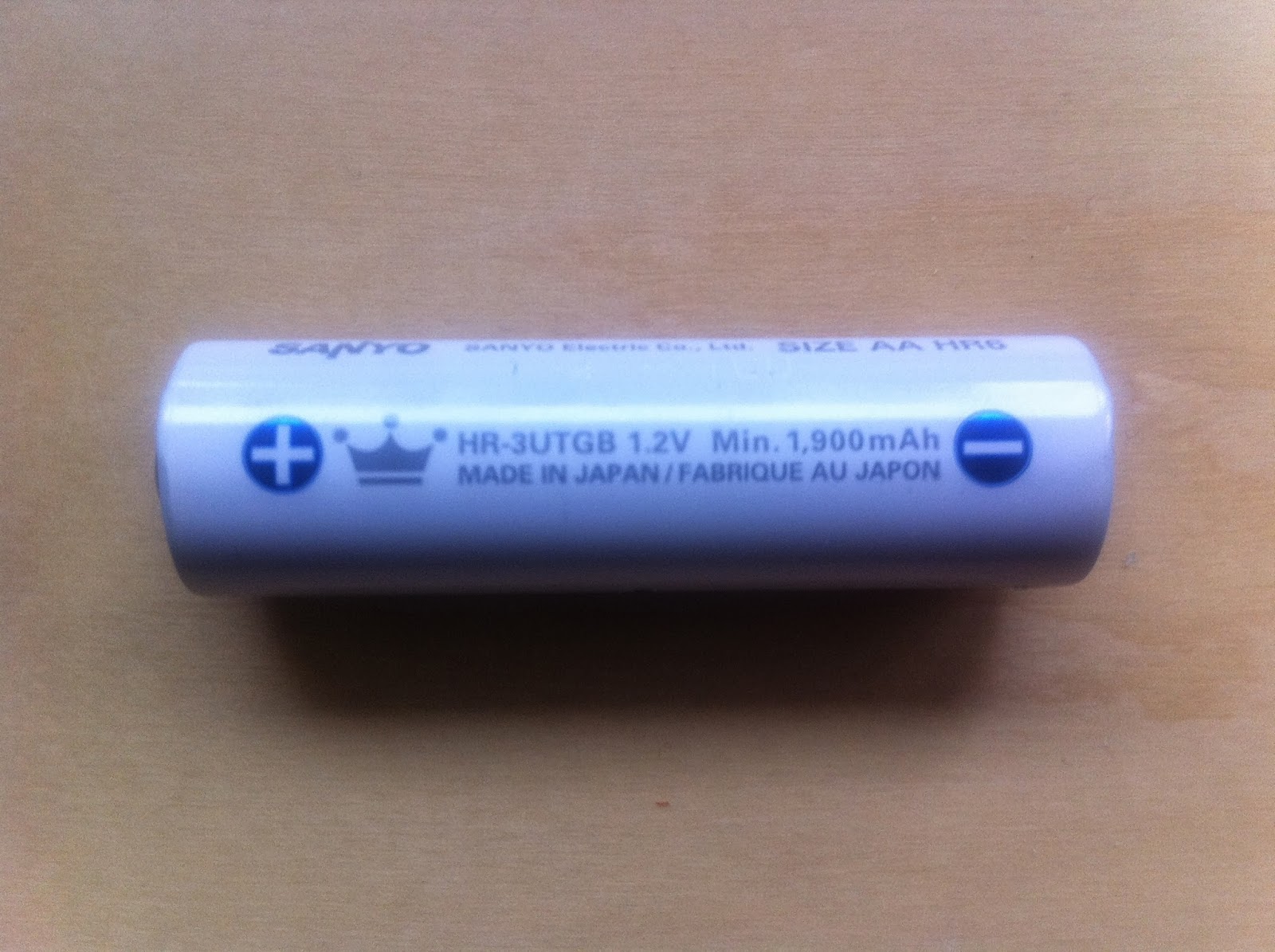
The different Eneloop AA batteries all have a code on them to identify the generation. The battery above has a code next to the crown. First generation are HR-3UTG, second are HR-3UTGA, and third generation are HR-3UTGB. The battery above is therefore a third generation battery. AAA batteries have a 4 in place of the 3, so a 2nd generation AAA has a code of HR-4UTGA.

The picture at right shows first- and third-generation AA batteries. Changes in layout and the addition of an EU "don't put in regular recycling" bug make it easy to separate these two if you know what you're looking for.

In store packaging, 3rd generation Eneloops have "1800" in orange prominently printed on the blister pack.

Third generation batteries have significantly lower self-discharge, so they can last for years in your emergency flashlight and still have most of a charge when the power finally does go out. They also operate at very low temperatures --important for bike lights and other outdoor uses.

And, of course, the 3rd generation batteries provide more charge cycles. You may not think you need 1800 charge cycle, but a high charge cycle rating means the battery will maintain its typical capacity over a higher fraction of those charge cycles, even if you subject it to high current, deep discharge, low temperature, vibration --in other words, a typical day in the life of a battery that works for me.

Rechargeable batteries are now so good that you can just use them for years and replace them when they seem tired. But if you want, you can get more performance out of your rechargeable batteries by periodically reconditioning them. If that sounds like becoming a full-on battery otaku, it' actually not a big deal, but I'll save that topic for another day.

10.02.2013

SAE What?

Here are the two most dangerous SAE screws to get mixed in with your ISO (metric, as in bike) screws. They are the 1/4"-28 and the 10-24, shown with the ISO screws they are confused with at right. The SAE screws are 1/2" long, the ISO screws are 12mm, slightly shorter. Shown here are button screws. Each "wrong" button screw will also take the "right" screw's Allen key, with a slightly loose fit.
  • The 1/4"-28, at bottom, is slightly bigger than the M6 above it, with slightly looser threads. When I hold two these at arms-length, I can't tell which is which, let alone identify one by iself.
  • The 10-24, second from top, has coarser threads than the M5 above it. This seems obvious, but doesn't actually take much carelessness to miss, especially if you don't work in a bike shop surrounded my M5 threads all day. The bottom of the 10-24's threads are quite a bit deeper than the M5's, but because coarser threads are thicker, the outside diameters of the screws are about the same.
What happens when an SAE screw is used by mistake on a bike? Nothing good, of course. In my previous post, I discussed my adventures with 10-32 screws and nuts versus M5, but all I wielded in anger was a thread gauge. This time, wanting to know the whole horror story, I got out the tools to wreck some hardware.

The 1/4"-28 is notorious for destroying bike bosses. I used a torque wrench to thread it into an M6 nut. The screw progressively stiffened to 20 Nm. At this point the screw was visibly cross-threaded into the nut. M6 screws are often torqued to 25 Nm or higher; on stems, aero bars, and the like. Threading by hand, it's obvious something is wrong, but a torque wrench is long enough to make 20 Nm easy to turn. But even using an Allen key, by the time it's clear that something is wrong, the threads on the bike are likely destroyed.

I backed out the 1/4"-28 and threaded in the correct M6, which promptly bound. Forcing it did not help. attempts to back the screw out again succeeded only in shearing off the screw. If I had conducted this experiment using an actual bike instead of a special stunt-nut in place of the bike, I would now have a huge mess on my hands.

Thanks to Adrian Burns for pointing out the perils of the 1/4"-28.

The 10-24 is insidious. It's easier to spot, but if missed, it threads in and appears to work. Yes, it's a bit stiff, but even with dry threads I never measured above 5 Nm. Once it's in, it appears to hold. Your rack or bottle cage is now mounted. But the bike's threads are trashed, and the screw will probably loosen. If thread locker doesn't help, you may try a new screw, doubtless an actual M5. Then the real grief starts.

I simulated this by tightening a 10-24 down to about 10 Nm. The screw wouldn't strip through at this torque, but it easily loosened. I then backed it out of the nut and threaded an M5 screw. This was stiff for a few turns as the M5 reformed the damaged threads. Then the M5 became rattle-loose in the nut. Now nothing will fit that hole until it is drilled and tapped for something larger.

I try not to keep any of these problem-child screws around, especially not in the heads and lengths used for bikes, especially in stainless, which is used a lot for bikes. If I feel like I have to stock one of these, I'll mark it on both ends with a red laundry marker to remind me that it's trouble.

9.29.2013

Oh SAE, can you see?

Today, I did something that I should have done a long time ago, and something that anybody who works on bikes (or cars, for that matter) in North America should probably do. I took M5 (metric) and 10-32 (SAE*) bolts and compared them side-by-side. The thread shapes and angles are the same. The M5 has pitch diameter of 4.48mm and pitch of 0.8mm. The 10-32 has pitch diameter of 4.31mm and pitch of 0.79mm. The SAE bolt is less than 5% smaller with pitch less than 1% tighter. See for your self in the picture to the right. (M5 on the bottom.)

An M5 bolt will thread into a 10-32 nut, and then bind, resulting in an insecure fastening and probably ruined fasteners. A 10-32 bolt will thread into an M5 nut, but won't hold. A 10-24 bolt's threads are obviously too coarse, especially if you have an M5 to compare, but it's still nearly the right size. If you use a bit of force, a 10-24 bolt will thread into an M5 nut a few turns, and then seize. If you keep forcing, you'll probably strip the nut. Most bike bosses are M5, so forcing a 10-24 bolt into a bike boss is a quick way to banjax a bike frame. Don't ask me how I know this. (The simple solutions are to either drill and tap the boss out to M6 or use a nut on the back side forever.)

In the second picture, from top to bottom: 12-24, M6, 1/4"-20. The M6 is the only one that I should let anywhere near my bike. The 12-24 will thread loose into an M6 hole, such as some bike rack bosses, but it won't hold. An M6 will thread a few turns into a 12-24 nut, but additional turns ruin the threads. Same with a 1/4"-20 and an M6.

A metric/SAE screw gauge costs $4. That's a one-beer tool. A metric thread gauge is $7, a beer-and-a-half tool. So I have these, and if I'm at all doubtful of the path by which a fastener came to be headed towards my bike, out come the gauges. It's much faster than half breaking a boss and then having to half-fix it.

And I keep my bike fasteners well separate from anything that might be SAE. Harder to do at home than it would be in a bike shop, but it's not that big a deal to buy a $10 plastic bin tray to hold just my bike fasteners, nothing else allowed. SAEs who? SAEs me!

*Yeah, yeah, I know there are no "SAE" fasteners since, 1949, when UTS superseded SAE. Go ahead and try to buy a "UTS" fastener in a hardware store. Thought so.

9.26.2013

Squirrel Eating Sunflower


The squirrels, or at least one squirrel in particular, have really taken a liking to Sven's sunflower.

There's a chill in the air. All the squirrels seem to be in a hurry.

9.25.2013

Front Fender

This is a setup I've had for about 5,000 miles. It broke, so I made it again, but stronger, so hopefully it lasts longer.

I wanted a front fender that extended in front of the brake, and I wanted to mount a light low. It all came together as a DiNotte 1200+, a piece of ABS, and a rack bracket bent over the brake as shown in the picture, to be fixed by the brake bolt.

It worked great for 5,000 miles, and then it broke, near the bolted end. Vibration-induced fatigue, obviously. So this time, two pieces of steel, together about 20% thicker than the original, deliberately separated a bit to damp vibration. Hopefully good for more than 5,000 miles.

I'm sure someone will complain that that fender is too high, and should be closer to better block spray. But it actually blocks a lot of water. By the time water is shedding off of the top of the tire, it's in a pretty thin line along the center most of the time.

9.15.2013

Parking: it's a skill.


September 13: SDOT SUV parked northbound in a no parking zone on Dexter Ave, blocking both a bike lane and a general traffic lane, right after a bus stop. This is downhill in a 30 MPH zone. (Just south of where Dexter passes under Aurora.) There are more dangerous places to park, but this one is pretty dangerous.

As soon as the driver saw me, she drove off. I didn't see whether she put down her cell phone first or not.

Update: I got this message from SDOT:

Hello,
This is not an SDOT vehicle. It is a standard city vehicle used by all city departments. SDOT vehicles have our logos on them in blue. I would need a license plate to have facilities folks identify the city department using the vehicle. Perhaps there was an emergency situation that the driver had to respond to a phone call; it’s hard to know the circumstances.

Thank you for contacting SDOT

8.09.2013

Corrosion --now in 3D

In reference to my previous treatise on battery terminal corrosion, you can now view a 3D image of a corroded battery terminal at the Lytro site here.

OK, probably, you don't want to do that. It's more fun than it sounds like, but still....


8.06.2013

Padding

Here is the outer (leftmost) brake pad I recently pulled from my front Avid BB7 disc brake caliper. The part of the pad closer to the hub is at right in the picture. The "top" of the pad furthest from the hub is at left.

The top of the pad still has some material left on it, so should I have let the pads go longer? No. Look at the second picture, below. This focal plane shows more clearly that the pad has not worn evenly, to the point that the copper "panhandle" that sticks out of the caliper has obviously been hitting the rotor during braking. Oops. So yeah, it was time to change the brake pads. (Both of these images are from a single picture from a Lytro camera.)

Measuring with a caliper, the top had about 1200µm of pad left, and the bottom had at most 300µm left.

Interestingly, the inner pad is worn completely differently. The inner pad wore evenly top-to-bottom, but the front edge had had 950µm and the trailing edge 1100µm. So the inner pad wore almost flat by comparison, except the leading edge wore a bit faster.

Why did the pads wear unevenly? Well, I'm not sure.

Maybe I didn't set the brakes up correctly? BB7s mount with spherical fixing bolts, so that you can align the caliper in two axes with the rotor. Avid's old instructions and Park's current instructions for this are laughably incomprehensible, so I figured out a simple way: put in new pads, set the pad distance. Squeeze the caliper shut on a trued rotor. Tighten the fixing bolts. So maybe that's wrong? I checked the Avid site. Avid's new instructions are pretty much exactly what I did. So that's not it: AFAICT, the caliper was set up with the caliper coplanar with rotor. There isn't much play in the caliper inboard and outboard, but even if there were, the caliper is designed to compensate for that by adjusting the pad positions. This is necessary, since hubs vary in exactly how outboard from centerline they mount the rotor.

Maybe I had let the pad positions get out of adjustment? The BB7 has two knobs to adjust the pads inwards as they wear. The outer pad is on a piston that pushes it towards the fixed inner pad. Obviously, the rotor makes an angle as it's bent, and obviously the force of the rotor is going to be higher on the top of the outside pad and the bottom of the inside pad. But that's the opposite of the wear pattern on the outside pad, and the inside pad wore evenly. So that seems unlikely.

Maybe the pads aren't coplanar? I doubt the caliper body is bent, since it's so stout that I find it hard to believe a blow hard enough to bend it wouldn't throw it completely out of alignment. The piston that pushes the outer pad in obviously has more play in it than the fixed holder on the inner side, so maybe this is just as good as it gets. One way to look at it is, I got 3 winters off of a set of brake pads that cost me less than $20. (The rear pads will probably last a couple more winters yet.)

Hmm. If you have any experiences or ideas, or interesting things to measure, I'm all ears.


8.03.2013

The Tomato Diaries

Sven is endlessly curious about math and frankly I'm a little worried that school next year won't give him enough to bite into. So he's signed up for 8th grade math in the fall and we've been doing a little math over the summer to make sure he had all the 7th grade bases covered. (He tested into 8th grade math, but these things aren't linear.)

I bought the school district's math book, Everyday Math and it's, how do I put this politely? A steaming pile of crap.

So we've pretty much had to write our own math book. The first unit to cover was probability and statistics. Everyday Math had a table of actual US immigration data and a series of measurements of an (imaginary) girl's head. The reader was expected to understand that one set of measurements was dominated by noise, whereas the other had inconsequential measurement error. I'm not sure why 8th graders are supposed to intuit this, given that many scientists have trouble with these concepts. But more importantly, all of the problems were boring.

So we decided to make some measurements of our own, so we'd have some data that we had a real feel for. What to measure? I figured nuts from the store, but a pine nut weighs around 3 grams, and our scale reports only to the whole gram. So we would have been overwhelmed by measurement error, which isn't normally all that much fun.

Sven thought of tomatoes from the garden. Much better. More variation than pine nuts anyway, and a light tomato is 25g. So good.

At right is our combined data from the first two harvests, conveniently of exactly 12 tomatoes each. X is tomato weight in 5g buckets. Y is count per bucket. Sven is predicting the third harvest will drive up our average weight and standard deviation. We've been looking at the data to see if it has an approximately Gaussian shape. We'll get more formal about that in a little while.

Corrosion

[UPDATE: see a 3D image of the corroded battery terminal here.]

AA battery packs are cool, but check for corrosion.

If your bike is transportation, or if you like endurance bike sports, you need bike lights. Hikers, climbers, spelunkers, and other outdoor sportsters also often need lights or other battery-powered devices. AA NiMH batteries are a cheap, effective solution. Damp weather and vibration can corrode contacts and degrade performance. Damp combined with vibration degrades performance faster.

The picture at right shows a corroded spring contact in a battery holder. This contact is at the bottom of the holder, and the spring at the top of the holder was not noticeably corroded, so moisture was the main problem here. (Leaking batteries cause corrosion too, although not in this case.)

GPS units that take AA batteries are notorious for vibration problems causing arcing, resulting a sort of electro-fretting that damages contacts on both the battery and the GPS. This is noticable because the GPS tends to reset whenever it loses power. The same problem happens with battery-powered lights, it's just hard to tell when it is happening. But the damage is serious. You can sand the corrosion off the contacts, but spring contacts are usually plated to combine long fatigue life with good electrical performance. Once the plating is corroded, the contact will never work as well again. Many GPS units now build Li-ion batteries into the device, eliminating this problem. Garmin makes a kit for their older GPS units with an extra tension spring to increase the spring force on the batteries. If you have this kit, I strongly recommend using the tension spring. It looks like an extra bit of hassle, but it is actually very useful.

One advantage of battery holders: replacing the battery holder also replaces all battery contacts. For example, DiNotte make nice lights that provide several hours of operation from a pack of four NiMH AA batteries in a standard "BH343" battery holder, shown at right. The holder has a connector like a 9v battery and cost $1-$2. Good NiMH batteries like Eneloops cost $3 each and a 4-pack will hold 10-12Wh.

I tape the batteries into the holders with electrical tape and use a battery pack charger (popular with RC enthusiasts) as I explain here. Taping the batteries seems to eliminate vibration problems. (Otherwise, the batteries will sometimes slip all the way out of the holder, a serious vibration problem!) But you then have to use a pack charger, which is very convenient anyway.

A battery pack is only as good as its weakest battery, so it's even more important to use good quality NiMH batteries when pack charging. I notice that after about two winters, battery life seems to get much shorter. So I tear the battery packs apart and recondition them with a La Crosse BC-700 battery charger.

Actually, a battery pack is only as good as its weakest link. I started scrutinizing the battery holders when I noticed that they would eventually crack, which reduces spring tension, and the connector to the light would also loosen, and would need to be (carefully, without shorting!) re-crimped once in a while. Then I started noticing corrosion. Once I started looking for corrosion, I started to find a lot of it.

I think 2 Seattle winters is probably all one of these battery holders is good for. After that, it's time to break down the battery pack, and recondition the batteries. The BC-700 tells me what the reconditioned capacity of each battery is. If it's over 90% of new, I put them into a new battery holder and give them another 2 years. Otherwise they get relegated to less demanding applications and eventually recycled. Either way, I now only use the battery holders once.

5.12.2013

Opener for the gate


The gate latch needed an opener for the other side. Has needed for a couple of years.

After some thought, I decided to use a bicycle shift cable that was plenty strong for this application, but had some minor damage that made me not want to put it on a bike. Putting the shift cable in a left-over piece of housing allows someone to pull down on the cable from the other side, pulling up on the catch for the the gate and opening the gate.

I cut a piece of dowel to use as a handle and threw in a carriage bolt I had lying around. Perfect. I used CATV brads to tack the cable housing to both sides of the gatepost.

Except, there is a problem with these latches: if there is even a very small upward force on the attachment, it keeps the latch open, so that the gate never closes. The cable moves very smoothly in the housing, so even a very light handle will drag the latch open. So now the gate has an opener, but the opener kept the gate from closing.

I thought a bit, and realized the solution was quite simple: remove the brad holding the housing on the inside of the gate. The housing springs outward, pulling the latch closed. Pulling down on the handle on the other side pulls the housing towards the latch, then pulls the shift cable through the housing, opens the latch, and opens the gate.

It's probably lucky I decided to use shift cable and housing. Modern shift cable housing is quite stiff compared to typical brake housing, so brake housing may not have been springy enough to work.

4.28.2013

A broken spoke: four views


DT Swiss straight gauge 2mm spoke. Velocity deep-V rim. Rear wheel, single-speed disk hub, so spoke tension is essentially the same on both sides. The spoke came just far enough through the nipple that I could cut a slot with a hacksaw and back the spoke out. The spoke was about three full turns from bottoming out the nipple. These pictures are of the piece of the spoke that was in the nipple.

Spokes break at the elbow. Everybody knows that. Why did this spoke break in the nipple? Manufacturing defect? Damage during wheel building (by me)? Some random damage from falling into one of Seattle's piano-swallowing chuckholes?

From the pictures, it looks like a fatigue failure from some damage near the end of threading on the spoke.

I took these pictures with the Lytro camera Aki gave me for Christmas. Not really a useful camera for portraits, but actually pretty good as a macro camera. Being able to take pictures with multiple, very thin focal planes is pretty much ideal for this kind of picture.

Thanks to Chris Heg for insights into what fatigue looks like.

4.10.2013

Traffic Hazard

This pole used to have a sign on it. The sign was either removed or stolen. Now there's just a pole. This pole is in the sidewalk approach to the Fremont Bridge southbound, where as many as a thousand bikes and (literally) uncounted pedestrians pass. (Bikes are directed onto the sidewalk here, to avoid the open bridge grating that motor vehicles use.)

At this point, traffic narrows to go over the bridge. Depending on traffic coming the other way, a bike rider or pedestrian may want to move near to where this sign is to give oncoming traffic a wide berth. (Pedestrian with dog, bike with trailer, drunk with attitude, etc.) This could easily cause an accident. Any sidewalk users could be affected, but it's obvious how this could be dangerous for a bike. The pole is hard to make out from the background, particularly on a cloudy day. Hanging up handlebars or a trailer on the poll could easily result in getting thrown from the bike, into bridge traffic.

It's a matter of time before something bad happens, and somebody rushes out to fix this.

[Update: I submitted this as an incident on Bikewise.org]

4.01.2013

Refactoring the Human Genome

I I am pleased to announce my participation in a bold new effort to refactor the human genome. This effort is without a doubt the most ambitious project ever seriously attempted to ameliorate the long term burden of human disease. The potential benefits are vast.

The team behind this project is a biology A-Team that I'm honored to be a member of. Heading up this effort: noted evolutionary bioinformaticist Dan Graur. The core team also includes renowned bioinformaticists Yichen Zheng and Nicholas Price, talented genomic architect Ricardo B. R. Azevedo, and population geneticist Eran Elhaik. Advisers include Larry Wall, fresh off the successful Perl 6 project; noted computer language theorist Edmund Arranga, and celebrated biostatistician and data analyst Lawrence Sanna. Beyond the specific technology, important philosophical guidance was provided by Francis Galton. This project makes use of important work by Francois Pinard, although he is not directly involved in the project.

The thesis of this star-studded group is simple, but like many simple things hidden in plain sight, it takes a true genius like Graur to realize the potential that lies before us, within reach. When you ask Graur why nobody has proposed such a project before, he just smiles wryly and shakes his head. "The human genome is rife with dead copies of protein-coding and RNA-specifying genes that have been rendered inactive by mutation. It's time we stopped passively accepting this situation and did something about it."

Our project: refactoring the human genome. "Refactoring" is a term from computer science, meaning to reorganize the internal structure of a code base without changing the (intended) external behavior. This term has been borrowed into bioinformatics, where the meaning is equivalent: the reorganization of the structure of a genome without changing the behavior of the organism. As Graur eloquently observed, at least 85% of the human genome is plain junk. Most of it is not transcribed, and even much of which is transcribed is by definition nonfunctional, because it is not subject to purifying selection.

Why does this matter? Even though it is not important to our normal genomic lives, this junk DNA is an important source of disease. Most obviously cancer, but also genetic disorders such as converse errors that can cause acute adhominem ataxia.

From an evolutionary viewpoint, a function can be assigned to a DNA sequence if and only if it is possible to destroy the function by removing the DNA sequence. Put another way: by definition, eliding nonfunctional DNA does not change the organism's function. Since 85% of DNA is nonfunctional, suppressing it has no effect on normal biology. Why is it worth eliding? Studies by Graur's colleagues show that transcription of junk DNA is highly active in immortal cancer cell lines. The implication is obvious: the key to curing cancer is to attack it at the root: junk DNA.

Thus our project, dubbed RECODE (short for "Refactoring to Eliminate redundant non-CODEing regions") will use well-understood recombinant gene technology. The result will be a human genome that is between one third and one sixth the present size. The project is ambitious. The benefits clear. The savings in file storage alone amount to millions of dollars a year, and will only grow as genome sequencing becomes more common.

Technically, the project is straightforward, although the bioinformatics is a challenge. The hardest part, and the part I'm personally most excited about, is ensuring backward compatibility of the new genome which we've taken to calling "H. sapiens 2.0" with the present "H. sapiens 1.0" genome. Personally, I'm not sure backward compatibility is actually essential, but politically, it's probably indispensable. For one thing, there is the installed-base to think of.

As often happens, backward compatibility will involve compromises. In particular, rebalancing chromosomes will probably have to wait for a future "H. sapiens 3.0" project. But an elegant implementation of backward compatibility gives humanity a smooth upgrade path to a genomically more healthy future.

This project is so new, it doesn't even have a proper web site yet. However, basic information is available here.

3.20.2013

Return of the road spikes

The city puts these spikes in the street to hold down air hoses for traffic studies. The spikes are supposed to be pounded flush with the pavement after they aren't being used any more. But as I've found (over and over and over) they are often not pounded flat.

This spike is on N. 34th in Fremont. It's on the south side of the street, maybe two meters from the curb, near the Sunday Market marker for stall 47, about where the new steel towers carry the new high-tension line cross the street. The Burke building is on the south side of the street here.

This is a busy bike route, with several bikes a minute passing through this way during rush hour. On Sundays, this is a very busy walking route, with people packed along the street in good weather.

If these spikes are not pounded down, they can cause a bike flat tire or even loss of control. Eventually they work their way loose. The resulting spike is several inches of hardened steel that can cause a serious injury to a person, a flat tire on a car, and other damage. This is why it's Seattle policy that these spikes get pounded down. Yet it doesn't happen. Now somebody has to take time out of their day to come back out and pound the spike down. It would have been better to do it right the first time.